A month of not reading Proust

Marcel Proust

I love Marcel Proust's In Search of Lost Time (À la recherche du temps perdu1). It's a monumental work, which I'm not going to attempt to summarise here, set in late 19th & early 20th century France, largely within the milieu of the Parisian upper classes, dealing primarily with time and memory but also adolescence, … Continue reading A month of not reading Proust

Asterix!

Asterix the Gaul

Earlier this year I happened across the 1980 Asterix annual in a charity shop; a book whose existence I was entirely unaware of. It was evidently a one-off, and provides an introduction to many of the long-running French comic series’ characters, along with heavily abridged versions of some of the stories, and the usual puzzles … Continue reading Asterix!

The Unmappability of Clive Barker

Weaveworld rear cover by Tim White

I wrote here (and more pertinently here) about maps in fantasy books, and for no justifiable reason I want to look at the ways in which the nature of Clive Barker's work is largely resistant to cartography. When we think of fantasy maps we tend to think of Christopher Tolkien's classic Middle Earth one (although … Continue reading The Unmappability of Clive Barker

The joy of film novelisations

Novelisations

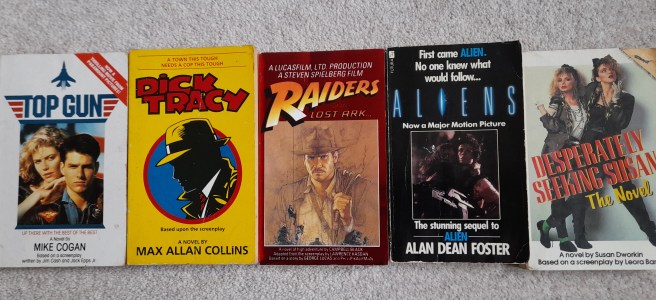
How does Star Wars begin again? Ah yes: “Another galaxy, another time.” That’s right. Wait – what? Star Wars geeks among you already know that the above is true – from a certain point of view. That’s because the sentence comes from Alan Dean Foster’s 1976 novelisation, published under George Lucas’s name. It came out … Continue reading The joy of film novelisations

First Frights: 50s Sci-Fi!

Around the same time I was watching Close Encounters for the first time, BBC2 were showing, in a weekday tea-time slot, a series of 1950s science fiction classics. This was my first exposure to older sci-fi, i.e. things that pre-dated 1977. I'm sure if I dug around the internet the evidence would contradict me, but … Continue reading First Frights: 50s Sci-Fi!

Horror Rewind special: James Herbert! (part two)

Read Part One The mid-1980s saw a change in Herbert's work, of which Moon (1985) although it contains many similar elements to The Jonah, is the first example. The hero of this transitional novel in Herbert's oeuvre has a "softer" name than his usual heroes - Childes - which reflects his vulnerability. He's a teacher … Continue reading Horror Rewind special: James Herbert! (part two)

Horror Rewind special: James Herbert! (part one)

"Politically the UK was still in turmoil, economically the country was very much in the doldrums, and culturally we were still living in the sixties, albeit without any of the verve, and certainly none of the optimism...power cuts and the three-day week...endless public sector strikes, IRA bombings and apparent industrial collapse...it wasn't exactly a dystopian … Continue reading Horror Rewind special: James Herbert! (part one)

First Frights: ‘Close Encounters of the Third Kind’ (1977)

TV shows had scared me before. But nothing had ever given me the true sense of awe that Close Encounters did (and, largely, still does) the first time I saw it. That's awe in the Romantic sense of the sublime, in which it borders on terror. Every time I watch the film, there's some new … Continue reading First Frights: ‘Close Encounters of the Third Kind’ (1977)

The work of John Higgs

There are some writers whose treatment of a particular subject you can almost predict. That's not necessarily a bad thing. John Higgs, though, is not one of those writers. This warm, witty and endlessly interesting writer is described (accurately, for my money) on his website as someone who "specialises in finding previously unsuspected narratives, hidden … Continue reading The work of John Higgs

The “Nouveau Roman”: where to start?

The Nouveau Roman was a French Modernist literary movement of the 1950s whose antecedents were Joyce, Beckett and Proust. A common theme among the works produced by those writers grouped as nouveax romanistes were "discontinuity, rupture, difference and revolution"¹, and they defined themselves against "a dominant culture in thrall to a staid and anachronistic concept … Continue reading The “Nouveau Roman”: where to start?