
How does Star Wars begin again? Ah yes: “Another galaxy, another time.” That’s right.
Wait – what?
Star Wars geeks among you already know that the above is true – from a certain point of view. That’s because the sentence comes from Alan Dean Foster’s 1976 novelisation, published under George Lucas’s name. It came out six months before the movie in order to stir up interest among SF fans, and at that point the familiar opening card (“A long time ago in a galaxy far, far away.…”) hadn’t yet been conceived.
Film novelisations – the fleshing out of a 20,000-word screenplay into a 200-page novel – are a once-mighty part of a studio’s marketing strategy: their raison d’etre was to whip up excitement for the product. The cover would be an eye-catching photo or (better still) the film poster, and as a bonus might contain eight pages of full colour pictures to fill out the images in the reader’s mind. Although still a thing, with so many other ways for today’s fans to partake in the movie ‘experience’ they’ve lost the primacy they once had. Because for all that even the writers would view them as hackwork – of little more substance or artistic worth than a promotional poster or TV-spot – many of these books sold millions, and some are still in print today.

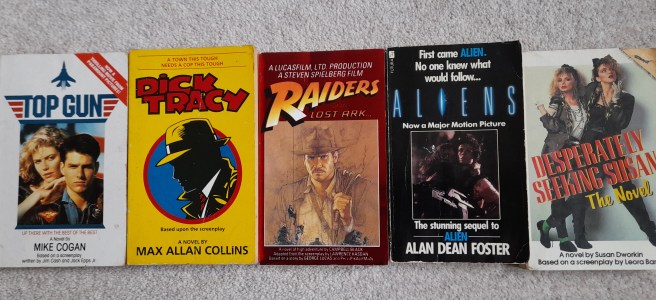
For the author they’re a mixed blessing. On the one hand, there’s no budget: they can make the action as big as they want, and their descriptions can be far more lavish (in the days before CGI) than the filmed backdrops. But on the other hand there’s still the risk – given that what they’re working on is not their own IP – of studio interference. Alan Dean Foster’s Aliens is every bit as enjoyable as James Cameron’s film, catching the right balance of tension and action, and follows it very closely with only a few tiny changes. However, Foster was forced to strip out almost all of what Hudson (in the book) or Frost (in the film) would call “harsh language”: “it was Warner [Brothers] that decided to bowdlerize the talk and have the Marines saying things like “Darn!” An absurd piece of censorship, but as it was a work for hire, I had no control over the final edit1.” This means Vasquez’s last words (which I always remember, for obvious reasons) are changed from “you always were an asshole, Gorman” to “you always were stupid, Gorman,” and Ripley’s most famous line – on seeing the Queen alien pursue a terrified Newt – is abridged to “get away from her, you.” Even if not directly interfering, studios can be very secretive about what’s being filmed, as Foster says about his novelisation of Ridley Scott’s original Alien: “I had to write the book without knowing what the alien looked like2.”
Writers also have time to spot holes in the plot. The author of the bestselling adaptation of Tim Burton’s 1989 Batman, Craig Shaw Gardner, says:
“Screenplays often don’t quite make sense. The images of a film fly by so quickly that the audience has been conditioned to accept what’s happening on the screen and maybe think about it later. The book reader, however, needs to see a certain interior logic. Every screenplay I have ever turned into the novel has needed to be “filled in” here and there in order for the written story to make sense. I try to do it as unobtrusively as possible3.”
For the reader, the book of the film could perform multiple functions. As mentioned above, it built excitement before the movie hit the screens, even at the risk of spoilers: a good example being Donald F. Glut’s novelisation of The Empire Strikes Back which, with one of pop culture’s all-time great twists, came out a month before the film.

If you had no cinema nearby, or it didn’t show the film in question, then a book version was a good substitute. Alternatively, if (say) Robocop was rated 18 (or in my case Highlander being a 15) and you were too young to see it and were neither lucky nor resourceful, well, thankfully books have no age rating.
Or, if you have seen the film then afterwards you can read the book to rekindle the action in your mind’s eye. Before the advent of home video, films had a run at the cinema and barring re-releases you’d have to wait years for them to appear on TV (if they ever did). Even in the early days of video, pre-recorded cassettes cost a staggering £70 (about £250 today) to buy, so rental shops were the only plausible means of obtaining them, and there was still a long gap before a film hit video, and longer still before it hit TV. In the early 80s, home VCRs were not common (and if you had a Betamax, chances are your local store’s supply was miniscule compared to their stock of VHS). Film novelisations therefore bridged the gap between watching and re-watching. Otherwise, all that existed was merch: comic, poster, toys, and the book.
But a good novelisation has value in its own right, offering things a film can’t. They can add a psychological depth by exploring character thoughts, backgrounds and motivations in a way a 90-minute movie just doesn’t have time to. The doyen of novelisations, Alan Dean Foster, says
“I go inside the characters’ heads, and I can also greatly expand upon minor characters. This is one way of turning a screenplay into a full-length novel. If you just change the screenplay to prose format, then you’ll end up with a 100-page book, which won’t work4.”
They can also add to the “content” of the film by showing what are in effect deleted scenes. Sometimes this is because of the contingencies of film-making: the writers may be working from an early version of a script, and publishing timescales mean the manuscript has to be finished long before the film sees release: plenty of time for directorial decisions to change (or studios to interfere). The five months William Kotzwinkle took to write E.T.5 was therefore unusually long. Alan Dean Foster again:
“I always receive the script well after the film is in production, so writing the novelisation requires very fast work in order for the publisher to have time to review, proof, revise, print, arrange for a cover, do the binding, and get the book to bookstores6.”
Thus, the reader gets bonuses that the cinema trip doesn’t provide. A few good examples are:
- Star Wars, which features much more of Luke on Tatooine, meeting Biggs and his other friends at Anchorhead (scenes we had to wait decades to see as Blu-Ray extras);
- Aliens, in which Newt’s family encounter the aliens;
- Campbell Black’s Raiders of the Lost Ark, which has several scenes in Germany tracing the growing involvement of Belloq with the Nazis;
- Ed Naha’s Robocop also has a much longer introduction showing the murder of a pair of cops out on patrol, and then of Murphy at home getting ready for his first day at his new precinct;
- Gremlins by George Gipe gives the Mogwai an (unnecessary) origin story;
- Gipe’s Back to the Future has a different beginning from the film. In the book Marty is in class, being shown a documentary film about nuclear testing from the 1950s. This stems from the original screenplay’s proposed ending, whereby the energy needed to get him back to 1982 (as it was then) could only be found by Doc and Marty going to the Nevada site of atomic tests. In a work whose clockwork precision is famous, this is a rare loose end that isn’t tied up: a small gripe because otherwise the book is just as much fun as the film;
- Susan Dworkin’s Desperately Seeking Susan – breezily ironic in tone throughout – adds a whole hinterland of backstory which the film doesn’t even hint at or really need, but which does its best to evoke what it is that makes Susan so cool, when of course anyone watching the film knows the answer: she’s played by the coolest person on the planet in 1985, Madonna.
Few of these “extras” are vital to the story – there’s usually a reason that scenes are deleted – but all are welcome. Sometimes such directorial decisions have to be addressed, as Craig Shaw Gardner explains:
“When you write a novelization of a film, you’re doing so at the same time as the film is actually being made. All film scripts change a lot as the director sees what works and what doesn’t. So the writer is sometimes given script changes for scenes he or she has already written, which then have to be rewritten to conform to the film7.”
There are things, of course, cinema can do which books can’t. Naha’s Robocop is very faithful, but it lacks the satirical punch of Paul Verhoeven’s film, and instead compensates for the loss of purely visual gags (Nukem!; “I’d buy that for a dollar!”) with a news story about Sly Stallone’s death after filming Rambo XXXVIII: Old Blood. Likewise, although the quips are all there, Larry Milne’s Ghostbusters makes up for the absence of Murray, Ackroyd and Ramis by having the narrative voice tend toward the wearily sardonic, which works well. Top Gun might seem a curious choice for a novelisation: in some ways it’s a purely visual film, and one of the original “high concept” movies: that is, one whose premise could be boiled down to a few words (in this case, a boy, a girl and an F-14 Tomcat). Tony Scott’s film doesn’t pretend to depth and is none the worse for it. Consequently, Mike Cogan ups the action, which can be a bit disorienting on the page.

Some novelisations, where the primary audience would be younger children, came in two versions: a standard one and an abridged “Young Reader’s Edition” with simplified language8. I knew my YRE of Empire Strikes Back inside-out, because I’d been a Star Wars obsessive for years before I ever saw the film. I also had a YRE of E.T.9, the existence of which makes sense after recently reading Kotzwinkle’s full-length version, surely the only book of a children’s film to mention LSD and DMT. In fact, it reads almost like an original novel rather than the transcription of a cinematic production. Character point of view in a book may be different from the film (James Kahn’s The Goonies is told by Mikey in the first-person), or handled in an unexpected way (in E.T., the alien is besotted by Elliott’s mum (which is fair enough: when I first saw the film as an 8-year-old, I had a crush on Dee Wallace too)) and the book diverges from the film about ¾ of the way through. The film was shot chronologically in order to get the most authentic performances from the child actors, so it seems likely that by the time Kotzwinkle was writing the later stages of the book, he was ahead of filming and of any changes to the screenplay that Steven Spielberg may have made.
Another novelisation which reads like an original work – possibly because at time of writing I still haven’t actually seen the film in question – is Max Allan Collins’s Dick Tracy. Collins had written Dick Tracy comics for over a decade and was therefore the only plausible candidate to write the book of Warren Beatty’s 1990 film. He evidently took to it not as a piece of hackwork but as an extended chance to play in a world he already knew. An editorial note at the start of the book says
“the following was freely adapted from the screenplay to the film Dick Tracy and draws on the rich sixty-year history of the great detective. While true to the story of the film, there are scenes and characters that do not appear in the finished motion picture.”
Then there are the outliers: those films which were based on existing works of fiction, but which diverged so much from the source that they then also had novelisations written which were truer to the celluloid version. Although Philip K. Dick’s fiction is ripe for adaptation, it’s for the ideas rather than the stories, hence the separate tie-ins of Blade Runner and Total Recall10.

Finally, the law of averages demands that some novelisations are better than the films they’re based on. Gordon McGill did a good job – until I finally saw the film – of making the lame Chevy Chase/Dan Ackroyd comedy Spies Like Us seem funny (or at least worth watching). Garry Douglas’s Highlander makes you wish, amid all the gloss and sparkle, that the film was just a wee bit better (although no book can successfully replicate Sean Connery’s Spanish – or Christopher Lambert’s Scottish – accent). Larry Milne’s book of Biggles: Adventures in Time also tries hard, but the notion of the WWI air ace having a “time twin” in 80s New York entrepreneur Jim Ferguson seems just as head-scratching in print as it does onscreen (although at least the reader can believe the war scenes are actually happening in Belgium, rather than Beckton Gas Works)11.
And while a movie dud can kill a director’s career, surely the author of a novelisation is immune? Well, usually. The Funhouse is a 1981 Tobe Hooper film, but before it came out writer Owen West developed the original screenplay into a successful book. When the film was belatedly released – and the novel was still in the bestseller charts – it wasn’t as good as it promised, and the book’s sales plummeted off a cliff. The result? Publishers Jove decided that Owen West had to die. Fortunately, “Owen West” was a psuedonym for the subsequently-hugely-successful horror/thriller writer Dean R. Koontz. In an afterword to The Funhouse, published now under his own name, he explained: “the script…offered enough material for no more than 10% or 20% of a novel” and he “didn’t use the screenplay until I had written four-fifths of the book.” He adds “ordinarily a film sells books…[but] instead of serving as an advertisement, [the film] acted as a curse upon it.”
Most can be picked up very cheaply in charity shops, second-hand bookshops or ebay although some (The Lost Boys, Predator) are hilariously expensive. They’re short and easy to read: not necessarily a sign of great literature, but that’s not what these are about. I’ve not yet found one I regretted reading, which is more than I can say for some books…
Notes
1 http://www.cultfilmfreaks.com/2019/03/alandeanfoster.html?m=1
2 ibid
3 https://comicsalliance.com/batman-89-novelization-adaptation-craig-shaw-gardner-interview/
4 https://lwlies.com/interviews/alan-dean-film-novelisations/
7 https://comicsalliance.com/batman-89-novelization-adaptation-craig-shaw-gardner-interview/
8 Craig Shaw Gardner’s Batman is not marketed as a YRE, but it’s as short and its prose as basic as if it was – which doesn’t make it any less enjoyable.
9 Online at https://archive.org/details/e.-t.-the-extra-terrestrial_202208/mode/2up
10 The latter is particularly fun, even if author Piers Anthony seems fixated on breasts.
11Both Larry Milne’s books mentioned here (Ghostbusters and Biggles) were published by Coronet and had fifteen pages or so at the end with “the making of the film” features, mini-interviews and profiles of the film-makers and cast. Milne (a pseudonym for Trevor Hoyle) tries valiantly to inject the excitement of W.E. Johns’s prose into Biggles but his research into early 20th Century military tech isn’t worn lightly.

 Into the Gyre
Great article and a belated happy birthday! As someone who grew up in the 80’s and 90’s this article is full of nostalgia. Like most of your others it is not just well researched (respect the footnoting) but also great to read. Really nice to see serious treatment given to stuff that isn’t literary fiction or “high art”. Also really liked two parter on James Herbert as well as the fascinating story of Oliver Frey.
LikeLiked by 1 person