
My copy was supplied for review; spoilers follow
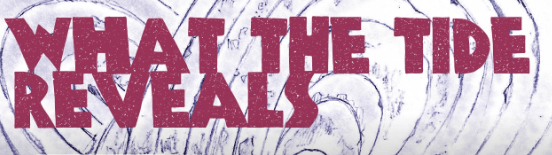
I reviewed Julian Payne’s previous work Harvest, co-written with partner Zoe Elkins, a few years ago for Horrified magazine. I said then that I looked forward to seeing what they’d do next. I have my answer here, in this gorgeous – and sizeable – graphic novel by Payne (Elkins, it seems, was editor this time around rather than writer). What The Tide Reveals looks big but some of that is due to the thickness of the paper; regardless, you’ll absolutely fly through it, and before we even get into details I thoroughly recommend it. I read it at Hallowe’en and it’s a suitably atmospheric and chilly tale, perfect for the shorter days and longer nights.
A team of six archaeologists take a boat to the (Hebridean?) isle of Skerra. Four of them (Cherry, Dido, Jacob and Olly) are students, led by Dr. Gordon Porter, famous from his daytime archaeology show; the sixth is enthusiastic amateur and blogger Rhona, who happens to be the only local.
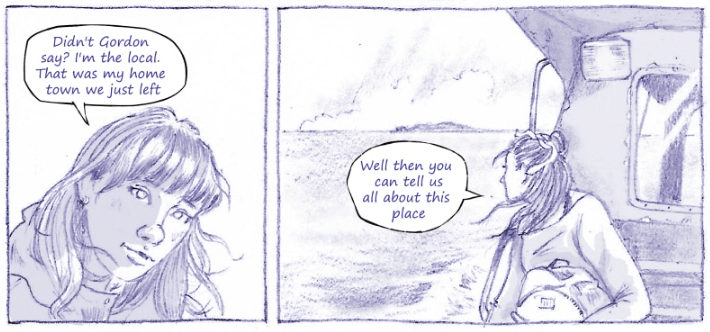
After an unsettling author’s note about the work – and mysterious fate – of the antiquarian Martha Tirion, whose work laid the foundation for all subsequent theories of Skerra, the first page shows us concisely, in three panels the vanishing mainland, the boat, and Skerra: what has been left, who we’re travelling with, and where we’re going. I noted I my review of Harvest that Payne excelled at landscapes, and his rendering of Skerra is never less than atmospheric: the first we see of it beyond a vague darkness on the horizon are two full pages of forbidding cliffs.
Introductions and backstory are deftly sketched in – we know nothing more than is necessary about our researchers, and that’s just fine. It quickly becomes obvious that Gordon Porter (who looks like Professor Ronald Hutton’s evil brother) maintains a one-sided, awkward sexual relationship with Dido, who seems to be midway in age between Porter and the students, and who keeps apologising on his behalf. Gordon also quickly shows himself to be a total creep, entitled and arrogant, who it’s (perhaps too) easy to despise.
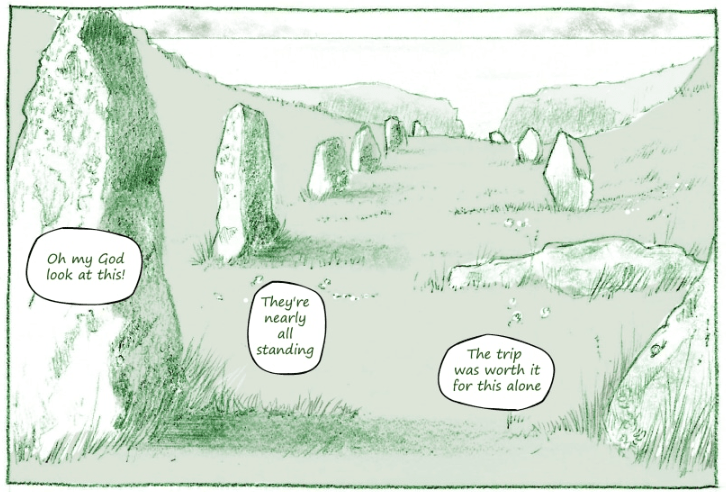
Almost immediately upon arrival, splits emerge in the group along lines of age, class and sex, even before they’ve explored the island. According to their map, Skerra contains an arrangement of standing stones and a chambered tomb, but maps never tell the whole truth. Naturally, they ignore the warnings from the skipper of their boat to camp on the beach, and head inland, where they begin to suspect that Skerra may not be entirely safe. Although it had been used for anthrax testing in the aftermath of WWII (like the real-life Gruinard), “it’s safe…signed off by the MOD”, Gordon reassures the credulous Jake. So that’s alright, then. Only the problem with Skerra isn’t to be found in recent history. It’s an island of death, used for funerary rites for a very long time.
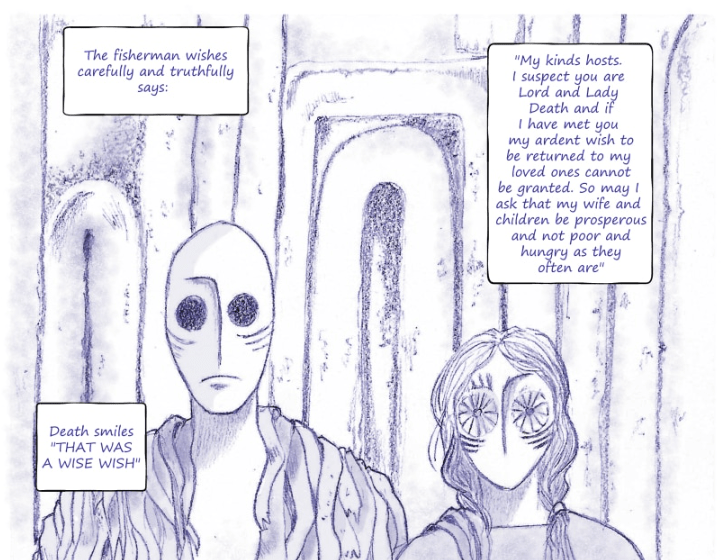
Rhona tells one of the stories attached to the island, where a fisherman is washed up and finds it inhabited only by a couple, the man dressed in a cloak of ribbons, and realises too late that they are Lord and Lady Death. This folktale is the key, the central motif around which What The Tide Reveals is constructed, which finds a visual echo in the knots and whorls that have been carved into the megaliths. In plot terms, as soon as this story is told, just like in Alan Garner’s The Owl Service, it becomes activated. “History, myth. It all repeats,” says Rhona, planting in the reader’s head that there’s a sense of inevitability to what’s going to unfold.
Sure enough, a storm leaves the party without shelter – other than the tomb – and food – other than what might grow on the island; like those mushrooms, for instance. Things quickly go very, very, wrong, and the body count rises, all because people touch things “that didn’t want to be touched.”
Everyone’s actions and words have consequences: words have power and are not to be uttered lightly. Towards the end we pin our hopes on the smart Rhona to be the Final Girl and make it back to civilisation. There’s a superb twist – a single, shocking act of violence – rendered across two pages in the only full-colour image in the book.
My only reservations are the author’s note (I’m not entirely convinced by the way in which Martha Tirion is made to tie into the story); and on occasion it’s a little difficult to distinguish between some of the characters. But otherwise, especially in the gorgeous dawn of the second day, Payne’s artwork is sumptuous, and the story is superbly constructed.
What The Tide Reveals is excellent, and as soon as I finished I re-read it immediately. As with Harvest, a re-read reveals subtle little details in the artwork: is that cliff shaped like a skull? And are those human shadows?
Highly recommended.

 Into the Gyre
“What The Tide Reveals” sounds perfect for spooky season! Graphic novel chills incoming!
LikeLike