
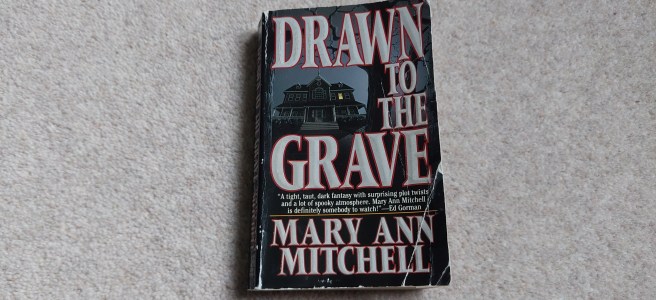
Regular readers of Horror Rewinds may well have noticed (though I alluded to it in my review of Skeleton Crew) that every book I’ve examined in the series so far was written by a man. “Sounds like a you problem” you may think, and so it is, but it’s a fact that most of the highest profile and biggest-selling horror authors during the boom of the late 70s to early 90s were men. There were exceptions: Lisa Tuttle, Anne Rice and Virginia Andrews are three names that don’t need any effort to bring to mind, but the fact that they come so easily to mind proves only that they were the exceptions. The horror genre at the time was by-and-large a male-dominated one, and the fact that that’s no longer the case is something to be celebrated.
Which brings me to Drawn to the Grave, the debut novel by Mary Ann Mitchell, a writer whose name I didn’t know, and who seems to still be writing and publishing (as of August 2025). Beverly is a writer, living on her own in the countryside and thinks that she has found the love of her life in near-neighbour Carl. But Carl has a terrible secret: he is only able to keep his own terminal illness at bay by means of an awful ritual. This ritual involves regular sex with women whom he then must make a near-perfect drawing of, and bury it deep in the earth (the “drawn” and “grave” parts of the book, almost as if the title came first). The ritual – which his victims (of whom Beverley is only the most recent) know nothing about – drains the life-force from women while simultaneously invigorating Carl, who sees himself as “a machine, steaming through the steely glare of daylight, pushing through his life to maintain the vigor that belonged to him”: that ironic “belong” is crucial, because of course the vigour is not his, and has been stolen.
Carl’s a sex-vampire; a spider for whom women are the flies. He’s a complete shit, finding Beverley (whom he claims to love, and it’s this love that seems to keep her living on beyond death) “too opinionated” (i.e. “has opinions”) and calls her a “witch”, hilariously oblivious to who it is in the book that’s performing the magic spells and rituals. Women as little more than a resource for men is a motif which is sadly, still horribly relevant today.
The actual mechanics of said ritual are, however, a bit unclear: Mitchell never leaves us in any doubt that Carl has ejaculated, but the nature of how the women’s own life force travels back to him is left unspecified, but then Drawn to the Grave is a fun book that’s like a run-down shack, where pulling at anything might make the entire building collapse.
The chief case in point is our new point-of-view character (after Beverly has been left undead), Megan. Megan is a young anthropology graduate on a hiking trip in the wilderness, left on her own since her room-mate bailed on her. She sees little wrong in staying with this man (Carl) who has shouted “you bitch!” out an open window to the darkness beyond, said “you should make peace with death” to her, and brought a revolver to breakfast: all fine, nothing at all odd, so she has regular sex with him, believes everything he says, and accepts his controlling, manipulative behaviour. It’s an odd horror, it has to be said, where the least inexplicable element is the magic life-prolonging ritual.
But Carl doesn’t get things entirely his own way: he needs a perfect visualisation of his victim so he can drain them, but the memory of Beverley is haunting him and interfering with his attempts to draw Megan exactly as she is. Beverley finally recruits Megan to her cause (i.e. revenge), and still Megan is too naive to see what’s going on.
The book rushes to a slightly confusing climax, and tacks on an unnecessary but also unsurprising epilogue. Oddly, it also had a prologue which, other than featuring Beverley having sex, had no other connection with the rest of the story. I kept expecting Mitchell to somehow tie up the themes introduced right at the start, but no.
I was also surprised that it isn’t just male pulp horror authors (such as James Herbert and Shaun Hutson) whose characters stand naked in front of mirror to examine their bodies: both Beverley and Carl do this. But there is, at least in the early scenes while Beverley is still (fully) alive, a female gaze or perspective on sex: “he was obviously confused but didn’t want to release her until he was finished”, a sentence it’s difficult to imagine a similar male author of the time writing.
As I said, it’s a fun pulp read despite (and indeed partly because of) the faults; and because Mitchell’s prose tends to be overwritten and breathless, Drawn to the Grave is guaranteed to ensure you can fly through the book’s 300 pages in an afternoon.
The book was published in 1997 – a good half-decade after horror had ceased to be a major cultural force – and thus makes it by some distance the most recent subject for a Horror Rewind. By the year 2000 Leisure books were, apparently, the only US publisher with a horror line, and also had Richard Laymon and Graham Masterton on their roster, so Mary Ann Mitchell was in good company. The company go all-out to capture and keep the horror fan, with an insert in the middle of the book publicizing the Leisure Horror Club, and multiple adverts at the back for other titles in the line, plus a SPECIAL TOLL FREE NUMBER you could call to secure your fix. Good on ’em.
What else was going on in 1997? Well, in the cinema there were some interesting developments: Scream 2, the intriguing Cube, and the Hellraiser-meets-Alien carnage of Event Horizon. Books? Well, not much that has stood the test of time, as far as I can tell. It’s notable that the year’s Stephen King book was one of his Dark Tower fantasy series rather than horror, and by the mid-90s, King’s horror books themselves had changed and become more small-scale and personal. But otherwise we were in the early years of a two-decade fallow period in horror publishing.


