A China Miéville top 10

To mark the BBC adaptation Miéville's The City & the City, here's a quick run-down of his oeuvre so far. All opinions my own. The City & The City. If one definition of great art is that it changes the way you view the world, then this is great art. Inspector Tyador Borlú investigates a … Continue reading A China Miéville top 10

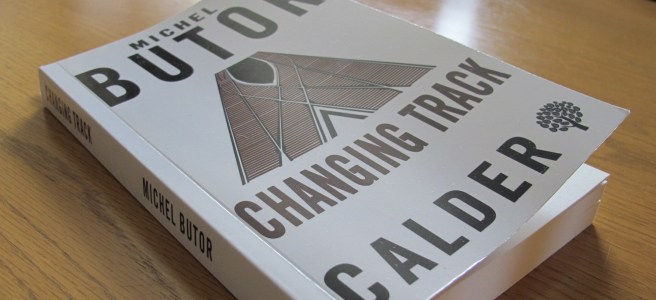
Review: “Changing Track” by Michel Butor

Changing Track, described on the blurb as "at once experimental and engrossing", was originally published by Calder Books in 1958 as "Second Thoughts" and has long been out of print in English. Alma Books have relaunched the Calder imprint1 with this, and other works from the Calder backlist are to follow later in the year. … Continue reading Review: “Changing Track” by Michel Butor

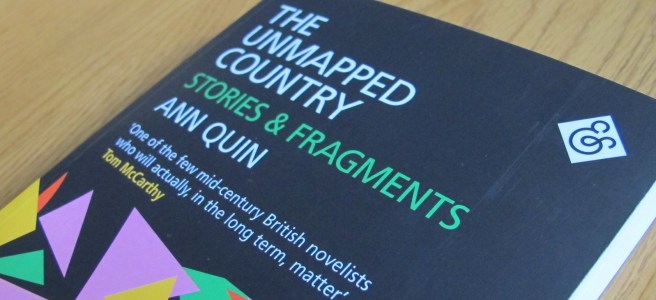
Review: “The Unmapped Country” by Ann Quin

It's a good start to the year for fans of mid-century experimental fiction. Alma have reprinted Michel Butor's Changing Track, and now And Other Stories have gathered these short pieces and fragments by Ann Quin. Quin, who drowned off Brighton beach in 1973 aged 36, has long been a cult figure. She was one of … Continue reading Review: “The Unmapped Country” by Ann Quin

All change: Jan Mark’s “Thunder and Lightnings” (1976)

In my previous post I wrote about nostalgia and the loss of contiguity that can trigger it. There are books, though, that I have always had: every house move has seen them boxed, shifted and unpacked; and, in time, re-read. For these books, each re-reading reveals new aspects: a form of anti- or a-nostalgia. One … Continue reading All change: Jan Mark’s “Thunder and Lightnings” (1976)

The lure, the lie and the lessons of nostalgia

"Proust had a bad memory...The man with a good memory does not remember anything because he does not forget anything." Samuel Beckett, 'Proust' To begin with, the first part of the quote above must look like exceptional contrariness on Beckett's part. Proust's most famous work is, after all, À la recherche du temps perdu (In … Continue reading The lure, the lie and the lessons of nostalgia

In praise of brevity: Clive Barker’s “Cabal” and the anti-epic

Clive Barker’s 1988 novel Cabal is short: at 253 pages, padded out by chapter breaks and illustrations, it’s practically a novella. After the effort of writing the 700-odd pages of Weaveworld, this was a refreshing length for the author: "One of the interesting things about going to Cabal after [Weaveworld] was that I found a … Continue reading In praise of brevity: Clive Barker’s “Cabal” and the anti-epic

Warp Records’ “Artificial Intelligence” series, 25 years on

I don't intend to write often about music on this blog, but a recent Guardian article reminded me that a group of albums that I love are approaching their quarter-century. Given that they transformed my musical tastes, I thought it worth revisiting them and the effect they had on me. Also, in an era where … Continue reading Warp Records’ “Artificial Intelligence” series, 25 years on

Alain Robbe-Grillet: early fiction (part 3)

In this final part of my study of Robbe-Grillet's early fiction, with today being what would have been his 95th birthday, I'll look at the novel which, for me, sees him reach the high-point of the nouveau-roman; and a series of experimental (in the true sense of the word) short fictions. By the time of … Continue reading Alain Robbe-Grillet: early fiction (part 3)

Alain Robbe-Grillet: early fiction (part 2)

In Part 1 of this essay I looked at Robbe-Grillet's first two novels (A Regicide and The Erasers), in which it is easy to trace the development of the techniques and motifs that he would refine and re-use throughout his career. The first novels are in many ways conventional, and this is because the techniques … Continue reading Alain Robbe-Grillet: early fiction (part 2)

Alain Robbe-Grillet: Early fiction (part 1)

If the nouveau roman (New Novel) had a driving force, it was Alain Robbe-Grillet (1922-2008). The nouveau roman was an influential - if rarely best-selling - literary movement in post-war France. A number of writers, generally but not exclusively connected to the publishers Editions de Minuit, sought appropriate ways to take fiction forward in a … Continue reading Alain Robbe-Grillet: Early fiction (part 1)