
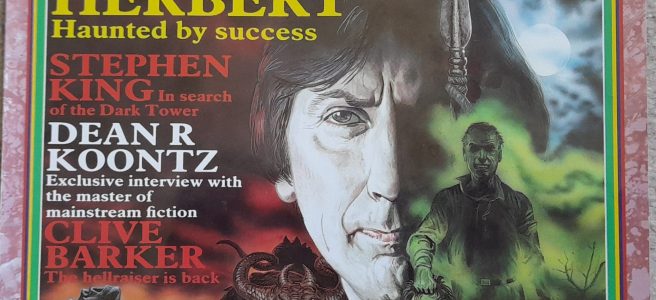
FEAR appeared at exactly the right time to fill a gap in the market. Although there were similarly-glossy genre magazines (Starburst, Fangoria, Samhain) their focus was on film whereas FEAR recognised there was demand for a magazine that covered horror fiction1.
As an avid reader of ZZAP!64 in the mid-80s, for their publishers Newsfield to launch a glossy magazine devoted to “the world of fantasy and horror” was tremendously exciting. Of course, Newsfield meant Oliver Frey: it was nice to be reunited with the Swiss-born artist’s distinctive illustrations; at the heart of the magazine there was knowledgeable, passionate journalism, led by John Gilbert2 and Philip Nutman.
Issue 2 contains virtually every major name in world horror in the 1980s. Just look at this list: James Herbert, Clive Barker, Ramsey Campbell, Dean R Koontz, Shaun Hutson: all interviewed. Stephen King (Dark Tower feature); Brian Lumley, Kim Newman, Stephen Laws (short fiction). Is that not incredible? There’s even an interview with celebrity genre fan Jonathan Ross.
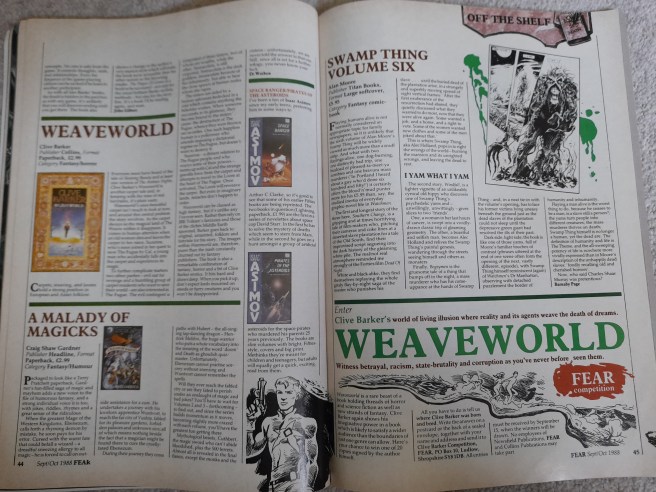
The News section is fun to look at now, where we first see mention of forthcoming films: David Cronenberg’s Dead Ringers has its release date pushed back, and Hellraiser III will be subtitled “Hell on Earth”3; or of books that presumably never saw the light of day: a Stephen King non-fiction book about gargoyles?
The main feature is a rare interview with James Herbert. He recalls his work as an art director at an advertising firm, where he worked by day while in his spare moments he wrote The Rats. He’s also quite candid about how he’s perceived within the horror genre, and how his fiercest critics are those within the genre, rather than those from the mainstream press: “they hate my success…[because] I’m not a purist as regards horror.”
In other interviews, Clive Barker reveals his thoughts on the imaginative process and on influences (“a slow accrual of realisations [rather than] a movie moment where somebody clicks their fingers and a light turns on above their head and they say ‘Gee! You know I’ve always wanted to be a writer!’ That certainly wasn’t my experience”). Dean R Koontz is very readable (and sensible) on the issue of how genre affects marketing, and how marketing affects reader expectations; Ramsey Campbell is also fascinating on marketing and has reassuring words for anyone who has written themselves into a corner while working on a novel (“somewhere earlier in the book is the seed of what you’re looking for now. The problem is already solved back there in the book if you want to look”).
Other interviewees are remarkably forthright in their opinions. Roofworld and City Jitters4 author Christopher Fowler detests the supernatural in horror – fair enough, though that does account for a lot of the genre. Nonetheless, the interview reveals a sharp intellect, and a desire to explore what the future of horror might be: diseases and computers, he suggests. Fantasy author Sheri S. Tepper has a more philosophical objection to horror. I don’t know which books she’s read but she’s quite strident about its “pessimism” and negativity, and assumes every character in horror is killed off. Furthermore, she suggests a link between the genre’s darkness and the “increasing suicide rates among young people” (I would suggest instead that the hopelessness engendered by a decade of Reaganomics played a far bigger role). Shaun Hutson, unsurprisingly, has no such concerns. Interestingly – amusingly – he says “I don’t write horror. I write comedy” which in some respects is true: the black comedy of his writing is part of the shlocky fun. He claims this by way of defence when his writing is accused of being “so bad it’s funny”, but doesn’t take issue with the idea that his writing is “bad” in the first place. This defensiveness is no surprise, given how – as I demonstrated in my Horror Rewind review of Spawn – there’s a neurosis at work in his prose; a need to dot every i and cross every t.
The letters page is revealing. Readers (including screenwriter Stephen Volk!) have had their chance to pore over the first issue and with a bi-monthly schedule there’s time for their responses to be printed. It’s here that FEAR’s niche-filling becomes evident: fans are overwhelmingly welcoming, and full of their own hopes and ideas for the fledgling magazine. Sci-fi and fantasy fans feel a little short-changed (the magazine is called FEAR, but they have a point), but editor Gilbert is quick to reassure them with a sneak peak of what’s to come in future issues.
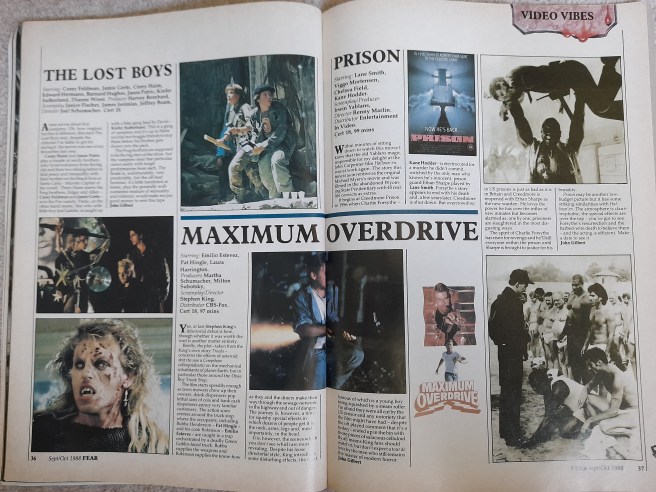
Film and book reviews are refreshingly (and sometimes brutally) honest. It’s amusing to note that films (The Lost Boys, for instance) now considered classics of the era were not universally loved on release. The Running Man (deservedly) takes some stick – it’s nowhere near the best Stephen King adaptation, nor the best Arnie film: hell, it isn’t even the best Arnie film of 1987 (that would be Predator) – but the passing of time has rendered it a campy cult classic. There’s also fun in seeing, amid the cast lists of straight-to-video low-budget horror flicks, early appearances by actors who went on to bigger and better things, such as Viggo “Aragorn” Mortensen and Miranda “Eowyn” Otto, amongst others. It’s also weird to see how a book as familiar to me as Weaveworld can have its plot summarised in a way that makes it sound strange and fresh once more.
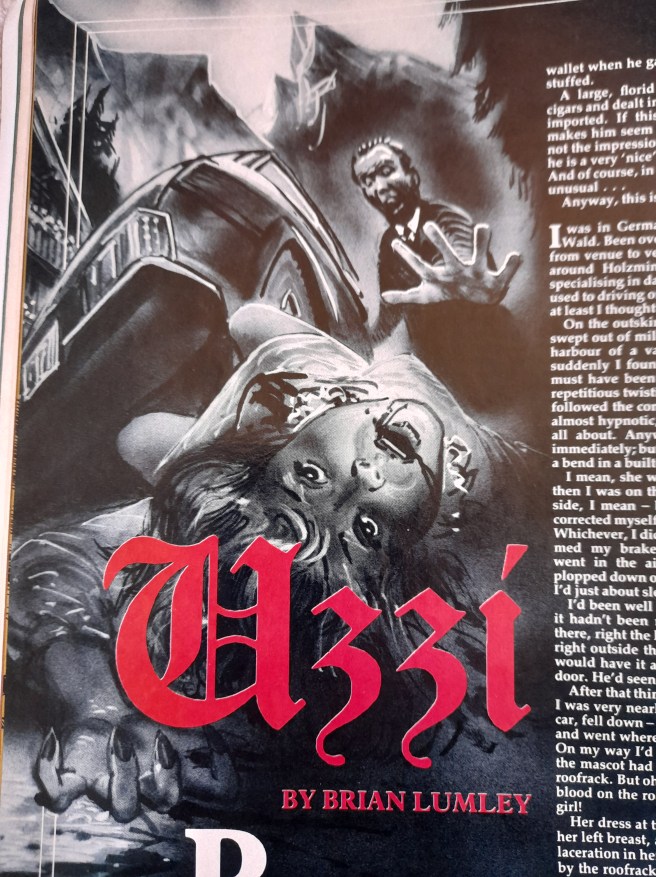
There are three short stories, each with a suitably lurid background illustration by Frey. Kim Newman’s “A Quarter to Three” is set in a 24-hour diner in what’s clearly Lovecraft’s Innsmouth, and although undermined by existing purely to set up a punchline, is still fun. That Necroscope author Brian Lumley’s “Uzzi” starts off well is the best I can say about it, but – to my surprise, given how harsh I was towards him in a previous Horror Rewind – “Guilty Party” by Stephen Laws is the pick of the bunch: a tense story set in the aftermath of a Christmas work night out, where protagonist Stuart faces both a shotgun and a birthday cake, and the choice between the two isn’t as easy as you’d expect…
FEAR ran for just over three years: issue 34 in October 1991 was the final one. By then, Oli Frey’s cover art had largely been superceded by photos, and – sci-fi and fantasy aside – the horror boom was over. However, Newsfield’s liquidation in September ’91 was the real killer blow. The 8-bit computer market was moribund, and the company’s flagship titles Crash! and ZZAP!64 were foundering as advertising revenue dropped.
Notes
1 Skeleton Crew – which is given a brief notice here in its first, fanzine, incarnation – would later focus almost exclusively on horror fiction and comics.
2 Gilbert in his editorial takes issue with the volume of film sequels being churned out (sound familiar?): “Jason [Vorhees] and Michael [Myers] were good in their day but let’s move on.”
3 Finally released in 1992.
4 Both worth tracking down
References
FEAR #2, Sep/Oct 1988

 Into the Gyre