
“A moment later, they plugged her into the network.”
Why the inverted commas around “Rewind”? Because this 80s horror thriller, unlike pretty much all the others I’ve looked at, is spookily relevant today.
The Californian town of Moonlight Cove is the scene of a spate of grisly murders and, as a result, an unlikely number of very hasty cremations. Documentary filmmaker Tessa Lockland has come here to uncover the truth behind her sister’s death, and undercover FBI agent Sam Booker likewise smells something fishy in the official explanations for some of those deaths. They join up with wheelchair-bound Vietnam veteran Harry Talbot (and his lovable dog, Moose) and bright local 11-year-old Chrissie Foster, who has seen the reality behind Moonlight Cove’s facade.
The reason is Project Moonhawk, a genetic experiment (of sorts) being perfomed upon the town by the New Wave corporation. The locals are being converted, by means of a series of injections, into New People: humans without messy, inefficient things like emotions. In short, a new breed that will soon People the entire world. Except there are T&Cs: everyone who has been converted is at the mercy of New Wave’s megalomaniacal CEO, Thomas Shaddack (think Alien: Earth‘s Boy Kavalier and you’re pretty close). And there are also side-effects, which Shaddack is in denial about: an increasing number of the New People, instead of evolving into new superhumans, degenerate instead into slavering alien-werewolf-insectoid beasts of pure appetite, and it’s they who are responsible for the killings. Our four heroes must find a way to alert the outside world to the threat posed by Project Moonhawk.
Okay, so many of the textural details firmly place Midnight in the milieu of the late 1980s, but the book’s concerns are more relevant today than in 19891. Sociopathic neo-fascist tech bosses are unfortunately no longer solely the stuff of fiction. New Wave have connected all of the phones and computers in the Cove into a single network – which Koontz likens to a “web” – and the freeflow of data throughout this web is a danger to our heroes, who need to remain concealed and carry out their mission without coming under electronic – or human – surveillance. And this is made harder by a further side-effect of Conversion: not everyone turns into a beast: those who work with the network find themselves converted into what are essentially cyborgs – flesh and silicon mutants who are much more terrifying than that description sounds. So New Wave’s network is augmented by the locals, allowing it to perform parallel functions.
Midnight2 is a rallying cry against the rampant individualism of Reagan’s 1980s, with Shaddack as it’s logical endpoint. Harry, confined to his wheelchair and his house, is so desperate for some kind of connection to the community that he observes them via his telescope (Koontz keeps his activities just the right side of creepy, but only just). Sam is a man with nothing to live for, so is forced to reckon with his own demons; Tessa loves life too much to stand by and see all emotion drained from humanity; and Chrissie is, as a child, the future, and one with a fertile imagination in contrast to the robotic New People.
There’s another more nuanced character who could be described as a “hero”, though, and that’s one of the New People themselves, the police chief Loman Watkins. Watkins has been converted, and has only a dim memory of feeling emotions, but that’s just enough to stir what was once a conscience, and he begins a solo quest to put a stop to Project Moonhawk. What’s more heroic than doing the right thing against your own impulses? Though I admit it isn’t easy to sympathise with a man who [spoiler alert] shoots his own son, but like I said: nuance.
One of the few weaknesses the book has is in the depiction of the regressives: the beasts are (explicitly) likened to xenomorphs, or (again, explicitly) Rob Bottin’s special effects in The Howling3. There is a half-hearted and unconvincing attempt to imply that the New People turn into these creatures because they have seen the films in question, but to me that just seemed to mask a paucity of visual imagination on Koontz’s part. But it’s a small complaint in a book that otherwise impressed me, in no small part because of its prescience: we’re willing dupes, complicit in our enslavement to the products of the tech bosses. We blame computers for our problems (or, historically, the devil) but it’s humanity – people – and our unwillingness to take responsibility (or our willingness to cede responsbility to the powerful) that’s to blame. Harry Talbot’s Vietnam experience left him with a broken body, but also an epiphany: “a spineless desire to get out from under responsibility is in our genes…most evil has its roots there.”
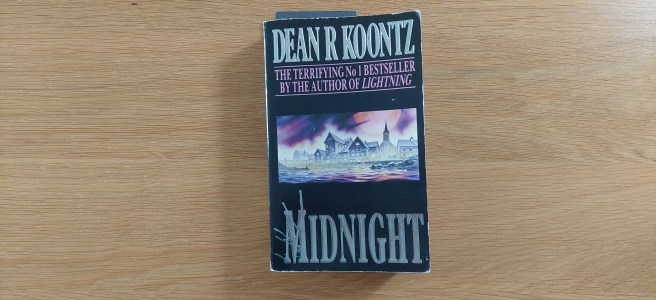
I was always sniffy about Dean R. Koontz when I was a teenager. I loved the house style of his books4, even if the cover illustrations seemed unrelated to the plot, but the blurbs never tempted me to spend £4.50 when there was probably a Stephen King or a James Herbert I could buy cheaper, or one of Clive Barker’s individual Books of Blood volumes, which were only £1.95! On the basis of Midnight, that was a mistake: even without the contemporary resonances this is a highly enjoyable and well-written thriller.
And if I sound surprised, I’m not alone. In an interview with issue 2 of FEAR magazine, Koontz revealed that he was well aware of his reputation, and the impact of genre marketing on sales and perceptions. “If [a] reviewer can be conned into thinking that he’s picked up some sort of straight, mainstream thriller or whatever, he’ll find himself liking it once he’s committed…but it’s irritating on behalf of other writers in the field who don’t get that kind of recognition because most critics and potential readers will look at the book’s stereotyped cover and say ‘Bah – I don’t like this!’ and never even give it a chance.” Midnight is worth giving a chance.
Notes
1 That said, you couldn’t make a faithful adaptation of Midnight today: the themes may be more relevant than ever, but too much of the plot and the action is dependent on 20th century tech.
2 The book’s title is, I suppose, ambiguous: midnight can be viewed as a beginning (as Shaddack would see it), or an end (as the Doomsday clock would have it)
3 There’s a bitter irony for a reader in 2026 in that Chrissie, having been chased by (as she imagines them to be) werewolves and aliens, wonders what might be next: Nazis? Because, I mean, if you’d read this in 1989, what was the chance of Nazis?
4 Koontz on the design of his U.K books following his move from WH Allen/Star: “very strong and stylish – and[don’t] descend to the worst impulses of illustration in this market…now that I’ve gone to [Hodder] Headline, the books look more like what they really are.”
Sources
Koontz, Dean R.: Midnight (Hodder, 1989)
FEAR issue 2, September/October 1988


