
At the same time as the 1980s horrorbrats of splatterpunk like Skipp & Spector were upping the gore to try to jolt readers out of their Reaganite complacency, there was a very different school of horror active: far more subtle but no less harrowing, acting as the Yin to splatterpunk’s Yang.
“Quiet horror”, as evinced by Charles L. Grant (whose The Pet was a highly enjoyable example, but whose cover art surely did it no favours) was, in Grady Hendrix’s words, about “suburban ennui, [and] families crumbling under pressure from suspected infidelities”. Campbell Black’s The Wanting ticks those boxes, even if the suburban ennui is dispensed with in the first 20 pages, and the infidelity is not suspected by the betrayed spouse until about the same distance from the end.
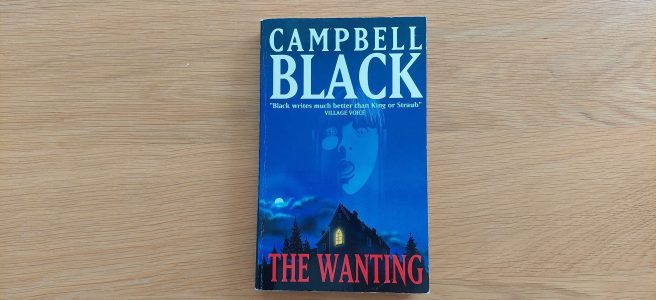
Glasgow-born Black, whose name will be familiar to genre geeks as the author of the novelisation of Raiders of the Lost Ark, also wrote the ubiquitous-in-the-80s thriller Jig as Campbell Armstrong, and though seems to have an otherwise very low profile (he died in 2013), was highly regarded by no less an authority than the Village Voice, whose quote adorns my 1991 edition’s cover: “Black writes much better than King or Straub”. If ever there was a claim to make a horror fan think “we’ll see about that” it’s this. And the truth of the quote? Well, writing isn’t a competition, and I’ve read both Straub and (plenty of) King recently, but Black doesn’t suffer by the comparison. In fact I can happily say that The Wanting is one of the very best horror novels I’ve read this year.
The prologue sees young cop Jerry Metger at a house in the deep, dark forests that surround the old Californian mining town of Carnarvon. He’s there to help find a missing girl. What he finds – and it’s no spoiler to say that he does find her, after a fashion – traumatises him so much that when, twelve years later (by which time he’s the local sheriff) another family moves in to the same house, also with a young child, he is immediately uneasy for reasons he can’t quite articulate. This unease, though, prompts him to start asking questions around the town, and to make connections, and he gradually realises that the history of charming tourist-destination Carnarvon is darker even than the forests that surround it or the mines that once sustained it.
Meanwhile, the novel’s central characters are the Untermeyer family. Mum Louise is an illustrator of childrens’ books, Dad Max is a GP, and there’s twelve-year-old Denny, whom Louise is very keen to remove from a San Francisco that is in the grip of a serial killer panic. Much safer out here in Carnarvon.
Isn’t it?
Max is keen to use this long summer vacation to try to end his extra-marital affair, and maybe wean himself off the pills he’s become addicted to in order to cope with the stress of maintaining a facade of normality. In the house in the woods, their only neighbours are the affable ex-hippy Frog, who lives in his VW and does odd jobs; and the elderly couple Dick and Charlotte Summer: charming, deeply in love with each other after decades together (how many decades, precisely?), and they’re very keen on Denny. They are lovely. Just lovely.
Aren’t they?
The family’s fault lines soon begin to widen: Max and Denny have no relationship, and the gulf between them is one that the Summers are only too eager to fill. Soon, Denny is spending all his free time with the old people in their ramshackle house (which seems to become slightly less ramshackle the more time Denny spends there). His youthful vigour rubs off on them too. At least, surely that’s what it is that makes Charlotte’s white hair regain its colour? And of course it’s perfectly normal for them to cut Denny’s hair…and keep it. And has Denny maybe picked up a bug or something during his time with them, because awfully soon he’s not looking at all well, while the old folks have a spring in their step…
Black structures The Wanting perfectly; the sense of menace growing around the family is slow but persistent enough, and is bolstered by Metger’s increasingly frustrated attempts to find out why so many children seem to have succumbed to a very particular and extremely rare illness in the town. The pacing, too, is superb, as is the sense of claustrophobia. Ironically, the deep dark forest is less claustrophobic than the smothering relationship the Summers have with Denny, or the drawing of the net around Metger as he asks questions that certain powerful people in Carnarvon would rather he didn’t. Black’s characterisation is strong: everyone is rounded, flawed and plausible (even the Hawaiian-shirt-wearing mayor) and we really fear for the Untermeyers right up to the gut-punch ending, a finale which made it one of those rare books that continued to haunt me for some time after finishing it.
Better than King or Straub? As I said, it isn’t a competition: horror is a broad field with room for everyone, and The Wanting holds its own alongside their work as a fine example of 1980s horror, well worth tracking down.


