
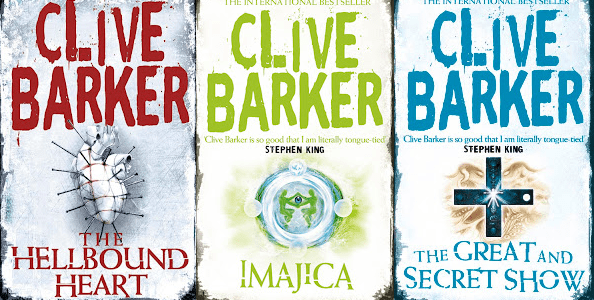
There’s a never-ending stream of subreddits asking “I’ve just finished [insert name of Clive Barker book]: what should I read next?” To help those new to Barker I thought it might be useful to suggest a number of ways through his work.
There are two obvious starting points for your journey.
- The Books of Blood, volumes 1-6, were Clive’s first published prose works of fiction. There’s a dizzying array of genres and styles on display here, not to mention some truly jaw-dropping ideas (In The Hills, The Cities is still astonishing, four decades on). Many of the stories, in hindsight, contain seeds of some of his later work (The Inhuman Condition‘s string puzzles > The Hellbound Heart‘s Lament Configuration box, for example), which could lead you off in multiple directions. From there you could take the chronological tour, with your next stop being the Faustian thriller The Damnation Game.
- The alternative starting point is 1999’s greatest hits compilation The Essential Clive Barker, a compendium of extracts with a few complete shorter works, too. It also includes extracts from some of his plays1, and a superb introduction by Clive himself. The book is structured thematically, showing links and similarities across the years, and he pens a brief introduction to each section. Read this – or even dip in and out of it – and see where it sends you off to.
However, if you’ve already begun your journey and it was from one of the starting points below, where should you venture next? Well, lace up your boots, make sure that puzzle box is securely stored, and follow me.
If you started at…
The Damnation Game: Marty Strauss is released from prison into the employ of wealthy businessman Joseph Whitehead, who made a Faustian pact decades before, and it’s time for the reckoning. More of a supernatural thriller than the horror of the Books of Blood, if you want more dark, long-buried secrets you could do worse than Coldheart Canyon. If you want another Faustian tale in an English setting, open The Hellbound Heart.
The Hellbound Heart: If you’ve read this and somehow aren’t aware that it was filmed as Hellraiser, then I can only assume you’re a newcomer to Clive’s work. In which case, welcome! And go and watch Hellraiser (the first one, from 1987; any of the sequels are at your discretion). I could send you off to The Scarlet Gospels, where you’ll meet Pinhead again, but as it’s his weakest book I think your best bet is to dip into the Books of Blood and travel from there.
Weaveworld: Barker’s breakthrough work, and his first step away from horror into dark fantasy, this epic tells of a world hidden from its enemies inside a carpet. My favourite Barker book (indeed, my favourite book and the source of this blog’s name), if you like the epic scale then head for Imajica; if you like the sweetness of Cal and Susanna’s relationship, then try Sacrament (or perhaps, Galilee); if you like the idea of a “hidden tribe” then read Cabal.
Cabal: The obvious next destination from this tale of misfit Boone and his entry into the world of Midian isn’t another book at all, but the world of its film adaptation Nightbreed (1990), directed by Barker himself. There was a surprising amount of promo material – especially given the studio’s attempts to ruin the film – all worth tracking down: the Nightbreed Chronicles (studio photos of the Nightbreed with pen portraits written by Clive), the Making of the Film (essentially an illustrated screenplay but there’s far more to it than that), the comic series by Epic (the first 4 issues cover the story and are the only essential purchases), Danny Elfman’s atmospheric soundtrack and, for those retro-heads among you, some 8-bit and 16-bit computer games, too. But the only easily-available item nowadays is the Directors’ Cut Blu-Ray, which is packed with extras. As for the next book to read, if you want something similarly short you could try the dark children’s fable The Thief of Always, although Weaveworld is, like Cabal, a tale of a “hidden tribe” but longer and more expansive. Alternatively, another story of a man with a troubled relationship to his past (but this time he actually has a past) is the under-rated Sacrament.
The Great and Secret Show: Being the First Book of the Art, you should immediately follow this metaphysical Californian Armageddon with the Second Book of the Art, Everville, and hope that by the time you’ve read everything else, Barker has finally published the Third Book of the Art. You could do a detour, though, and familiarise yourself with his recurring detective Harry d’Amour, either via The Last Illusion (in Books of Blood volume VI) or the standalone short story Lost Souls, before you meet him again in Everville. And if you find you’re enjoying Harry’s company, then Barker’s third film Lord of Illusions, while patchy, does have a note-perfect performance from Scott Bakula as d’Amour.
Imajica: Probably Barker’s masterpiece: from here you could either unroll Weaveworld, or take a dip in the dream sea of Quiddity in The Great and Secret Show.
The Thief of Always: This poignant and spooky haunted house fable of stolen childhood is a little gem in Barker’s ouevre. For more books aimed at children and young adults, the Abarat series is the obvious next port of call.
Everville: If you’ve read this before The Great and Secret Show, then that’s your next stop, and then follow the Harry d’Amour trail thereafter. Alternatively, if you liked the dream sea of Quiddity and want more maritime adventures, then visit the archipelago of the Abarat. Otherwise, maybe the wonders on display in Imajica or Weaveworld?
Sacrament: Wildlife photgrapher Will Rabjohns has a near-death experience that sends him on a quest back to his childhood and an encounter with a mysterious couple. Poignant, thoughtful and urgent, a meditation on environmental destruction, this is one of Barker’s quieter works, and one of his most powerful. After this, try Weaveworld or perhaps Galilee.
Galilee: Subtitled “A Romance”, this multi-generational epic is quite unlike any of Barker’s other works. If this is your first Barker, then something more representative, but equally epic in scale, like The Great and Secret Show, Imajica or Weavworld may be to your liking.
Coldheart Canyon: A deliciously perverse tale of old Hollywood secrets, The Great and Secret Show would be a good next stop, or perhaps Sacrament.
Abarat: There are three of the YA Abarat books so far, so read them all (if you can, find the lavishly-illustrated hardbacks); there’s more to come, but until then you could try The Thief of Always.
Mister B. Gone: A curio, perhaps, this comic tale of a demon escaping from Hell into the very book you are reading, but there’s an obvious next stop in The Yattering and Jack from the 1st volume of Books of Blood, and from there why not read the other volumes?
The Scarlet Gospels: If this is your first Barker, proceed immediately to The Hellbound Heart and then follow the Harry d’Amour adventures via The Last Illusion, then The Great and Secret Show. Or go back to Hell with Mister B. Gone. And kudos for reading his most flawed book and still wanting to discover more.
If you started with a film, head for the source:
Hellraiser (1987): the film adapation of The Hellbound Heart.
Nightbreed (1990): the film adaptation of Cabal.
Candyman (dir. Bernard Rose, 1992): stylish adaptation of The Forbidden, from Books of Blood volume V
Lord of Illusions (1995): flawed but interesting adapation of The Last Illusion, from Books of Blood volume VI (but see The Great and Secret Show, above)
If you started via any other film, TV show, game or comic, then head to the top of the page and either start with the Books of Blood, or the Essential.
Books about Clive
So you’ve exhausted all of his (easily-available) work and want to probe a little deeper? No problem. Here are the best ones to whet your appetite2:
The Dark Fantastic by Douglas E. Winter – the official biography. Winter is an excellent, highly astute writer and this is everything you’d want from a biography, telling the story of Clive’s life (up to 2002, anyway) with analysis of each of his works (book and film). Indispensable for the Barker fan.
Shadows in Eden, ed. Stephen Jones – a lesser-known treat, this is chock-full of pretty much every interview with Clive (covering the period up to Nightbreed (1990)), introductions he wrote for other books, snippets from reviews (some of which are hilarious), and thumbnail artwork. If you want to know what Clive’s opinion was on pretty much anything in the 1980s (or even just to get a snapshot of the horror scene in that decade), this is where you’ll find it. A treasure trove.
Clive Barker: Dark Imaginer, ed. Sorcha Ní Fhlainn. Not for everyone, and some of the analyses you may well disagree with, but it’s heartening to see Barker get the academic treatment his work and influence merits.
Clive Barker’s Dark Worlds, ed. Phil and Sarah Stokes – the coffee table retrospective. Sumptuously illustrated, covering everything from his earliest films in the 1970s, through the Dog Company theatre years, to his breakout with Hellraiser, right up to his 70th birthday in 2022.
Here at the Gyre, there are some of my personal takes on his work:
The Folk Horror Chain in Clive Barker’s Books of Blood
Clive Barker: “Candyman”, “The Forbidden”, Place, Race & Time
Notes
1 Of which I’d recommend The History of the Devil and The Magician, both available from the Clive Barker Archive.
2 There are more: see https://www.clivebarker.info/relatedbooks.html and https://www.clivebarker.info/relatedbarker.html


One thought on “A Clive Barker Itinerary”